


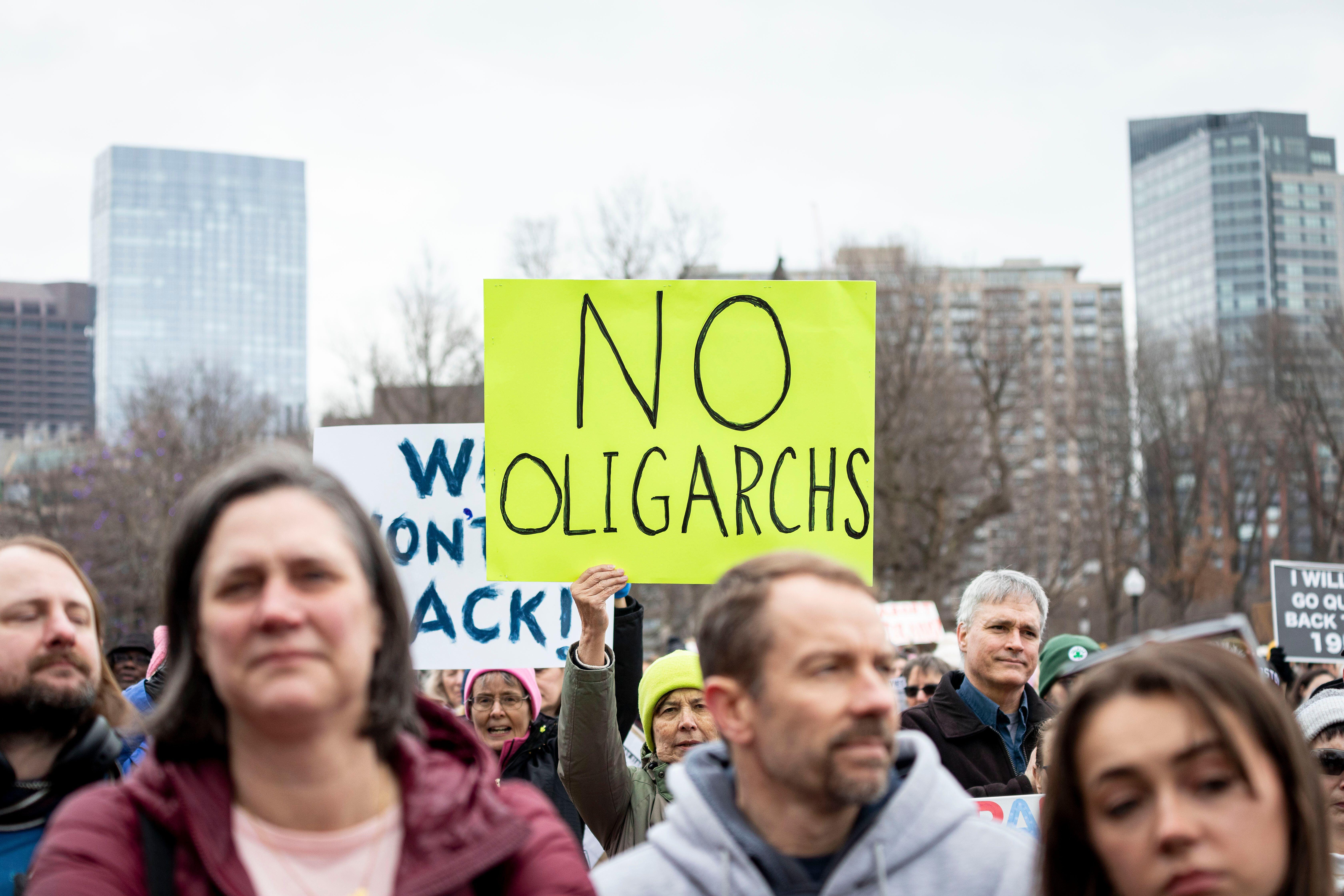
For years, members of Congress have traveled to their states and districts and heard variations of the same complaint: “Life feels much harder than it should.”
Behind much of that dissatisfaction lies a common throughline: Americans feel they have less power than ever before over the political and economic forces shaping their lives.
Decisions are increasingly made by people and institutions that have become larger, further away, and much more difficult to challenge. That includes a dysfunctional Congress, massive corporations that reshape local economies, a precedent-shattering Supreme Court, and the fast-swelling power of Big Tech oligarchs.
Large bipartisan majorities believe wealthy interests and major corporations wield too much influence over politics. The desire for major changes to both our political and economic systems runs deep.
Voters may not use phrases like ‘distributed power,’ but they recognize its absence.
Some lawmakers recognize this too and are beginning to translate that dissatisfaction into a pro-democracy platform that recognizes that democratic freedom and economic freedom are intimately intertwined, and that aims to restore real economic and political power to everyday Americans.
An emerging agenda to restore power to the people
This Congress, a dozen or so lawmakers have introduced legislation aimed at breaking concentrations of corporate power across a range of industries.
Some proposals would restore fair competition where dominant firms have come to control essential markets: breaking up big medicine and Big Ag, or revisiting illegal mergers waved through during the Trump administration, especially in media.
Others would protect people and independent businesses from corporations that increasingly function like private gatekeepers. Rep. Becca Balint and Rep. Nydia Velázquez’s Online Sellers Bill of Rights, for example, would establish basic protections for small businesses that depend on dominant online platforms to get to market. Sen. Mark Warner has proposed legislation establishing rules for AI agents to help ensure they serve rather than control people’s digital lives.
Still other bills target financial models that reward short-term investor gains over long-term growth, including proposals to limit stock buybacks for government contractors or restrict private equity’s role in industries ranging from children’s sports to defense.

Viewed individually, these proposals can look like a laundry list of fixes. Viewed together, they begin to look like a governing philosophy that puts power back in the hands of people.
That represents a meaningful departure from the economic consensus that dominated Washington for much of the last half-century.
A shared power alternative to the old economic consensus
For decades, policymakers generally operated from the neoliberal assumption that markets worked best when government intervened as little as possible and that larger firms often brought greater efficiency. Questions of market structure, local ownership, bargaining power, or industrial concentration were frequently subordinated to a simpler measure: whether consumers paid lower prices.
But the concentration of economic power that resulted has made that philosophy increasingly difficult to defend.

The 2008 financial crisis exposed the dangers of concentration in finance. The pandemic revealed the fragility of supply chains dependent on a handful of firms. Inflation brought renewed scrutiny to the pricing power enjoyed by corporations in concentrated industries. Private equity expanded into hospitals, housing, veterinary medicine, and other institutions central to everyday life.
And now artificial intelligence is taking off just as a small number of technology companies finish consolidating extraordinary control not only over computing infrastructure, but also over news, advertising, and information, online commerce, and more.
These different crises cannot be understood simply as isolated market failures. On the contrary, they all pointed to the same one question of power: who has it, who does not, and what happens when private institutions become so big they can dictate terms to workers, consumers, businesses, and entire communities.
That distinction matters because Washington’s economic debates have long centered on what government should do after the market distributes income and opportunity unevenly: how much to tax, how much to spend, and how much assistance to provide to people left behind.
Those debates remain important. But the emerging politics of power asks a different, more basic question: Why allow corporations to accumulate enough power to suppress wages, dictate prices and terms, eliminate competitors, extract wealth from communities, and bully politicians in the first place?

This distinction is especially important for progressives today to relearn. Competition policy, restrictions on private equity, protections for independent businesses, and limits on corporate gatekeepers operate further upstream than most other progressive policies. They seek to restructure markets where too few entities control economic power in the first place.
That is a different kind of economic program.
A politics that scrambles traditional party lines
One of the key aspects of this shift is that it does not fit neatly within traditional partisan categories.
Progressives tend to emphasize the effects of concentrated corporate power on workers, consumers, and democratic self-government. Conservatives may focus more heavily on national security, local institutions, financialization, industrial resilience, and the influence of dominant technology companies. But even though the diagnoses and prescriptions can diverge considerably, lawmakers across the political spectrum are increasingly confronting versions of the same question: How much power should any private institution be allowed to exercise over the lives of Americans?
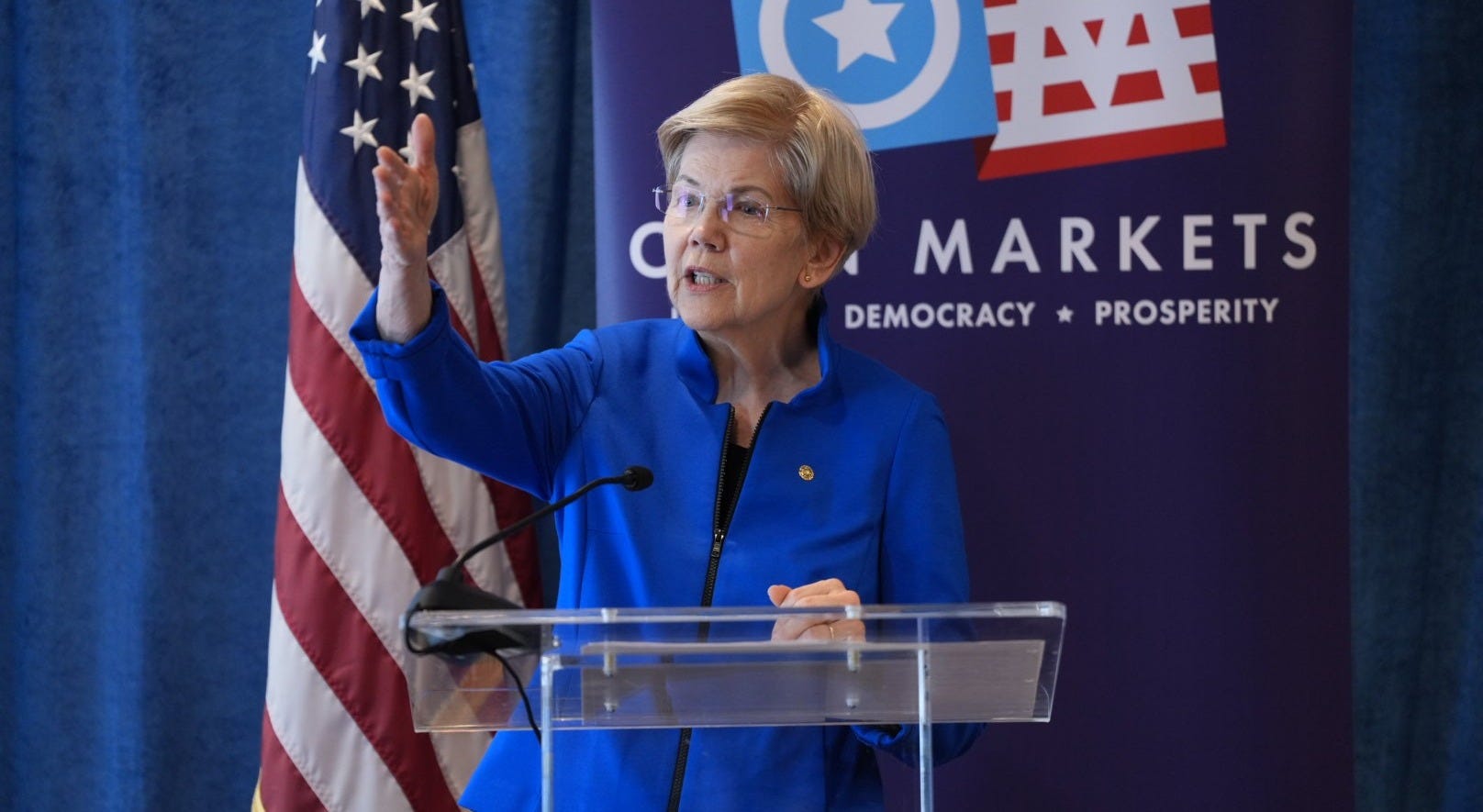
That convergence was visible at the Open Markets Institute’s conference this June.
Rep. Chris Deluzio and PA Rep. Chris Rabb argued that people have lost patience with moderation and want leaders who will take on concentrated corporate power. From the right, Chris Griswold of American Compass pointed out that the defiance of private tyranny is as American as defiance of kings. Independent Senate candidate and labor leader Dan Osborn said that a wide range of voters are looking for leaders who will genuinely fight on their behalf.

Bipartisan interest is also visible in Congress. The 21st Century ROAD to Housing Act that became law this July brought together senators as ideologically diverse as Elizabeth Warren, Tim Scott, and Bernie Moreno. Major proposals to check the power of Big Tech, including the AMERICA Act and American Innovation and Choice Online Act, have likewise attracted bipartisan support.
Perhaps that should not be surprising. America’s anti-monopoly tradition has often reached both sides of the aisle. Theodore Roosevelt was a Republican. Louis Brandeis was a progressive. Both understood that excessive private power could threaten individual liberty just as surely as excessive government power could. Our constitutional system rests on the very same insight.
Building a governing agenda for 2027 and beyond
The range of legislation necessary to address concentrated private power goes far beyond what can pass this Congress.
But by writing and introducing these bills today, lawmakers are building a shelf of proposals that can be quickly reintroduced in January 2027. If control of Congress changes hands in the elections this November, the next majority will not have to begin its economic agenda from scratch.
That matters because any new congressional majority will face immediate choices about what kind of economic program to prioritize.
One approach would focus primarily on repairing or reversing existing policies and using taxes and public spending to address affordability, inequality, health care gaps, infrastructure, manufacturing, and other economic needs.
A distributed-power agenda would add another dimension: restructuring markets so that corporations have less ability to create those problems in the first place, and less political power to fight efforts to regulate their power and behavior.
The next Congress can help a family afford necessities. It can also ask why a tiny handful of corporations enjoy such vast power to determine what those necessities cost.

It can provide assistance to farmers while also ensuring farmers have multiple buyers competing for their products. It can support entrepreneurs and creators while also preventing a dominant marketplace from imposing unfair terms and conditions.
It can begin to break up corporate control over our news, information, and entertainment, in ways that immediately strengthen our democracy.
The two approaches are not mutually exclusive. But the latter has been largely absent from mainstream economic policymaking for decades. Now there is increasingly legislation ready to put it into practice.

Writing durable laws with immediate enforcement
There is a second, less visible evolution happening alongside the change in economic thinking. Lawmakers and policy experts, like those in the Monopoly Busters Caucus, are considering how to write legislation that produces “self-executing” and durable reforms.
New laws that depend heavily on executive agencies for rulemaking and enforcement can take years to produce visible results. They can also be delayed, weakened, obstructed, or eliminated by lobbyists and administrations hostile to their purpose.
Some lawmakers and policy experts are looking for ways to write requirements and remedies directly into legislation and put the burden of compliance on corporations themselves.
Legislation from Senator Chris Murphy and Rep. Chris Deluzio that targets private equity’s role in children’s sports, for example, places requirements directly on firms to certify they aren’t practicing what the bill’s authors call “vulture” or extractive financing, rather than relying entirely on a lengthy administrative process to determine whether corporations are complying with the law.
This ability to deliver immediate results through the crafting of powerful legislation should help determine the governing priorities in the next Congress. Congressional leaders deciding what to advance in 2027 should choose bills that quickly and visibly improve people’s lives, and do not put the burden on law enforcers to discover and prove the crime.
An agenda to distribute power more broadly is ultimately about freedom
Members and allies working to check and distribute the power of corporate actors can also make a broader case for their agenda: it can help restore voter faith in American democracy by demonstrating that people truly enjoy real control over both public and private institutions.
Democratic freedom means people have real choices, meaningful opportunities, and the power to change and challenge decisions affecting their lives.
A worker with multiple employers competing for their labor has greater power to demand better wages and conditions. An entrepreneur who can choose between different marketplaces and ways to reach customers can build a business without depending on the whims of a single gatekeeper. A local newspaper with multiple ways to reach readers and advertisers can invest in journalism rather than operate at the discretion of one technology platform. A family with access to competing, locally accountable health care providers receives better care.
When meaningful alternatives disappear, people have less freedom and power shifts upward. Wages stagnate, costs rise, independent businesses struggle to compete, and decisions shaping people’s lives come from institutions they cannot meaningfully influence.
The focus on shifting power toward more people is what makes the emerging legislative agenda grounds for some optimism.
Such proposals, of course, did not appear out of thin air. The work has been happening for years: Rep. David Cicilline’s investigation of Big Tech; Elizabeth Warren’s decades-long focus on corporate concentration and financial extraction; the antitrust revival under Lina Khan and Jonathan Kanter in the Biden administration; growing Republican concern about Big Tech; and bipartisan alarm over private equity extraction and manipulative AI algorithms, have all played a role in setting up this moment of real opportunity.
Together, the proposals taking shape demonstrate that lawmakers are beginning to rediscover a governing tradition that sees preventing concentrated economic power as a basic responsibility of democratic government.
This progress in thinking and legislating will not resolve every economic debate in the next Congress. But it offers something American politics has been missing for a very long time: a way to connect the cost of living, competition, individual freedom, and democracy within a single governing idea.
A free society requires limits not only on government power, but on private power too.
These State AGs Are Jamming the Gears of Trump’s Power Consolidation Machine

On the evening of March 18, California Attorney General Rob Bonta led a coalition of eight states in filing a federal lawsuit to block the politically charged merger of two of the country’s largest local television broadcasters – Nexstar and Tegna.
