



In June last year, Governor Josh Shapiro stood in front of an excavator and a crowd of construction workers in Berwick, Pennsylvania, to herald Amazon’s plans to spend $20 billion building a network of AI data centers across the state.
He then delivered a speech he would rather we forget.
Flanked by Amazon officials in an announcement tightly choreographed with the company, Shapiro spoke of “working closely” with Amazon and local leaders to speed up permitting to ensure “the future of AI runs right through Pennsylvania.”
For the self-described ‘Get Shit Done’ Democrat who built a national brand on pragmatism, bipartisanship and economic development, attracting Big Tech investment must have seemed like a clear political winner.
But this August – in what the Philadelphia Inquirer branded a “major shift” – Shapiro signed an anti-data center executive order laced with ferocious rhetoric, decrying “predatory” developers whose bad proposals were “infecting” the state.
Feedback from voters had shaped his perspective, Shapiro said, as he signed an order strengthening local veto rights, requiring data centers to cover utility costs, banning nondisclosure agreements and removing them from a fast-track permitting process.
“We will not be bulldozed by the lawyers working for these big tech companies,” he said of the partners his administration had last year worked with to speed up approvals. “We have a long history in Pennsylvania of industry running roughshod over our communities to make a buck – that stops with me.”
Across the country, community rage at data centers has caught leaders on both sides flat-footed. Republican candidates are attacking Democrats; Democratic candidates are attacking Republicans.
The same week Shapiro signed his executive order, his opponent launched a data center attack ad: “Shapiro sold us out,” it blares, accusing him of pocketing $5 million in campaign cash from out-of-state data center developers (numbers which seem dubious).

What was seen as a fringe left issue in early spring has now been embraced as a key campaign issue for the midterms. The DCCC is advising candidates and external groups to go on the attack over data centers in over a dozen competitive races.
A memo from House Majority PAC, the Democrats’ main House Super PAC, described it as “the most notable and unforeseen” issue in the midterms that is “animating voters across the political spectrum.”
But the speed and breadth of the backlash – and public opinion research from both industry groups and Democrats about what is driving it – suggests the fight over data centers may be just an early front in a much broader revolt against Big Tech.
The open question: Whether Democrats can get ahead of a charged issue which has taken them by surprise, successfully wedge their rivals, and build a new coalition of voters around a broader challenge to Big Tech’s growing power over our economy, our politics and our lives.
The Backlash Beneath the Backlash
In early 2026, many dismissed the rising community anger about data centers as a local issue driven by NIMBYism and concern about utility rates. Today, few still hold that view.
“The fact that it’s so local and tangible is what moved public opinion the fastest,” said pollster Adam Carlson with Zenith Research. “Especially when people are already hurting from an affordability crisis – anything that could even theoretically add to their monthly bills is a complete non-starter, electorally toxic,” he said. “But that’s not the only factor.”
Polling by Milltown Partners, which has a range of Big Tech clients, indicates the backlash is “driven by anti-tech sentiment more than NIMBYism or environmentalism” and is “underpinned by populism on both sides of the political divide.” Underlying it all are strong feelings of unfairness, distrust, and a growing rage against extractive business models, they found.
“The industry thought that the public would relish the wild, wild west and the speed of change and the speed of innovation, and that’s simply not true,” said veteran pollster Celinda Lake. “The public are very, very regulatory oriented.”
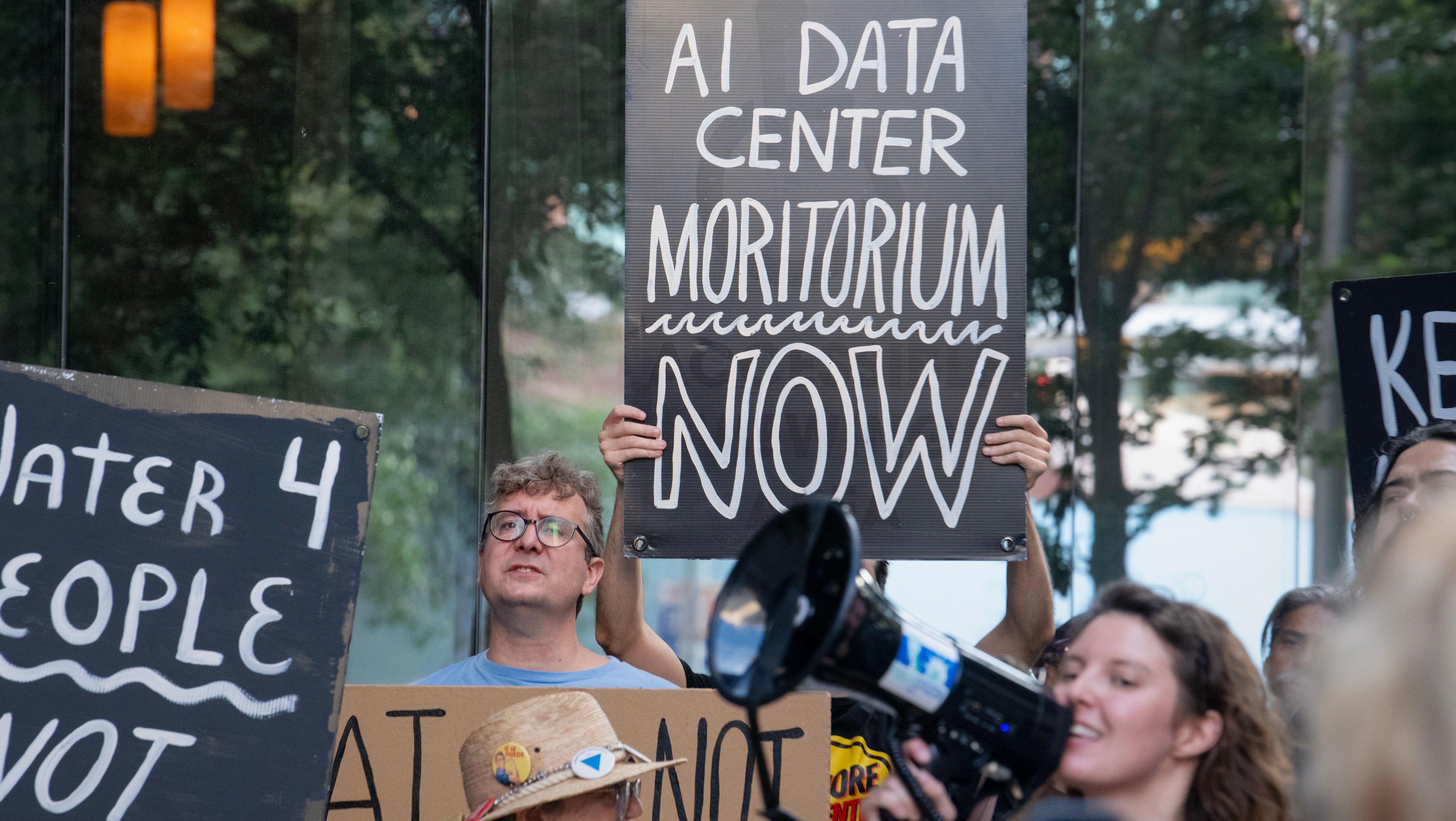
A tracking poll by Heatmap shows that public division on data centers 12 months ago has rapidly consolidated into outright opposition – with 75% opposed to a data center being built near where they live (a 33-point swing). It’s a striking shift, especially since it occurred absent any coordinated political or advocacy campaign behind it.
From Servers to Surveillance
Sprawling data complexes offer a perfect political storm: Anxieties about AI, Big Tech and corporate power colliding with utility costs and affordability concerns. They have become a symbol of an industry that once prided itself on “moving fast and breaking things” – taking what it needs, leaving others to pay the price, and rarely asking permission.
They’ve given communities a rare, tangible chance to fight back against Big Tech forces that otherwise feel distant, opaque and beyond their control – tapping into anxieties neither political party has yet managed to channel. The anger is no longer staying local. It’s spreading fast.
Flock cameras – a network of over 120,000 automated, AI-enhanced license plate cameras that enable law enforcement to track vehicles’ movements – are triggering a similar wave of organic opposition across party lines, with voters unconvinced by arguments about community safety and their utility to law enforcement.

This week, Independent Montana Senate Candidate Seth Bodnar uploaded a video firing a bullet into a security camera and delivering a message that connected Flock to privacy to data centers. “The whole thing isn’t just creepy as hell, it’s also part of a massive economy designed to buy and sell our personal data,” he says. “All this data needs a place to live in the cloud, so that’s why they wanna build data centers right in our backyards.”
The issue cuts across party lines. A recent Washington Post analysis found that right-wing social media accounts were posting outrage against the “mass surveillance network” more than three times as often as left-wing accounts.
Governor Shapiro won’t be caught out again: Last month he came out in support of bipartisan efforts to ban Flock cameras – with similar criticism from governors in Texas, Florida and Rhode Island.
It’s not just the physical manifestations provoking a response either. Pollsters pointed Liberty and Power to a range of looming AI flashpoints – from surveillance pricing to child safety to algorithmic healthcare – that are already provoking intense voter anger and rapidly moving into the political mainstream.
Charting The Backlash
First in Congress to read the room on data centers was Senator Bernie Sanders, who in December 2025 endorsed a moratorium to “give democracy a chance to catch up, and ensure that the benefits of these technologies work for all of us, not just the wealthiest people on Earth.”
In barely eight months, Sanders’ proposal has leapt from the far left to the dead center. In a number of key races this year, both Republican and Democratic candidates are racing to cast – or hastily recast – themselves as anti-data center fighters willing to stand up to Big Tech.
According to a Politico analysis, the majority of competitive House districts – 40 out of 69 – have data centers planned or under construction.
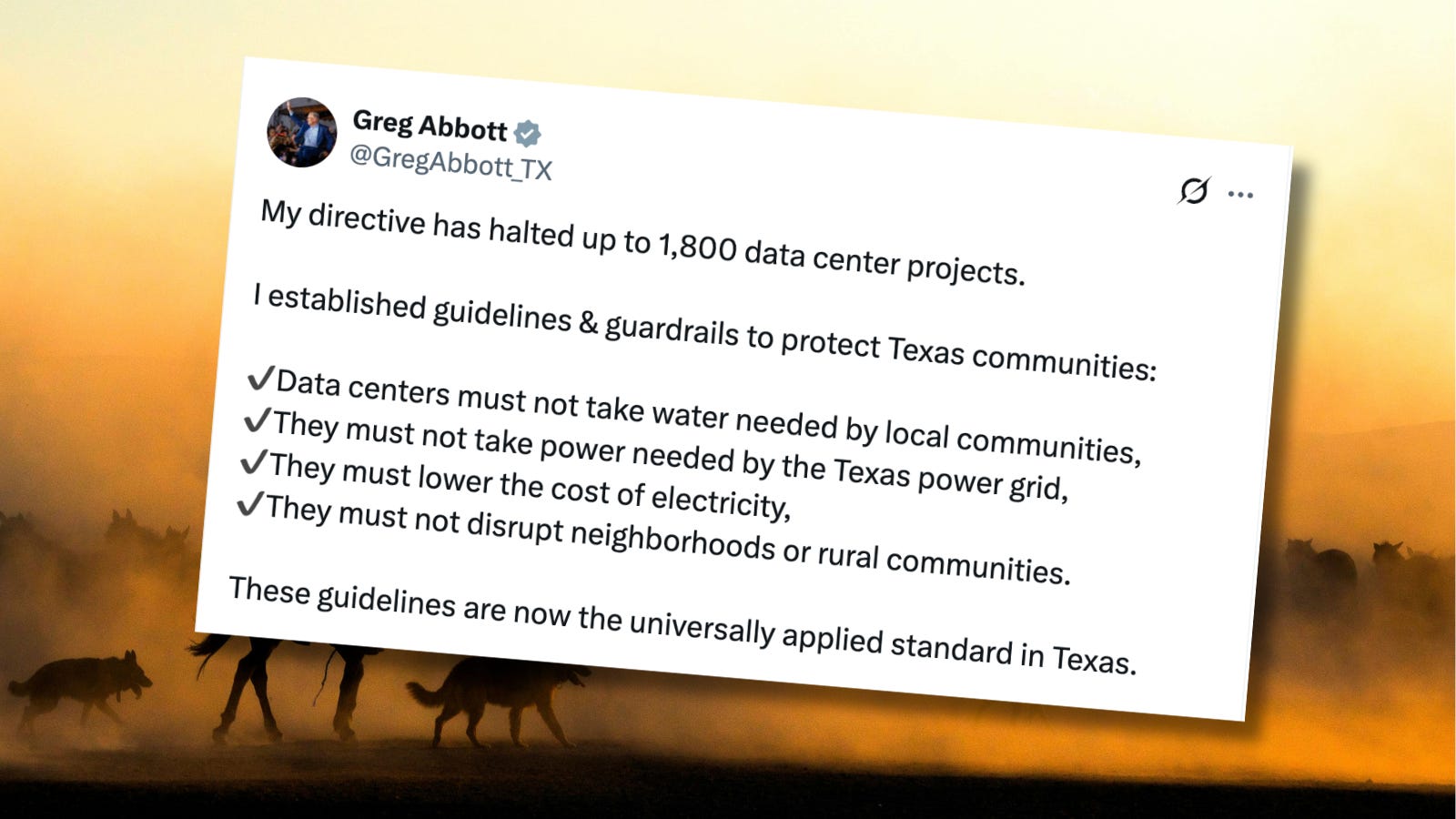
In Texas, Governor Greg Abbott has executed a 180 on the issue in less than a year, with his Democratic challenger, state Rep. Gina Hinojosa, branding the state a “wild west of data centers.”
Last year, Abbott lauded Texas as “the epicenter of AI development.” Now, he’s backing a slew of anti-data center policies: removing tax incentives, banning construction in rural neighborhoods, and effectively pausing new data center utility connections. “My directive has halted up to 1,800 data center projects,” the ostensibly pro-business governor claimed on X.
In Ohio, Republicans are panicked that the rebellion could cost them a Senate seat.
In a leaked memo, the National Republican Senatorial Committee warns that former Democratic Senator Sherrod Brown’s data center attacks on Senator Jon Husted are devastatingly effective. “He force fed the massive energy sucking facilities on the state,” one ad intones, “giving corporations over $2.5 billion in out-of-control tax breaks.”
“Brown is using it because it works,” warns the NRSC memo, leaked to AXIOS in an apparent effort to get Big Tech allies to take the issue seriously. “Data centers are the anchor hanging around Husted’s neck,” it reads. “This has become a sleeper issue for the entire election cycle.”
In Wisconsin too – where mainstream Democrat David Crowley just pulled off an upset primary victory against democratic socialist Francesca Hong – Republican gubernatorial nominee Tom Tiffany made data centers the subject of his first wave of attacks.
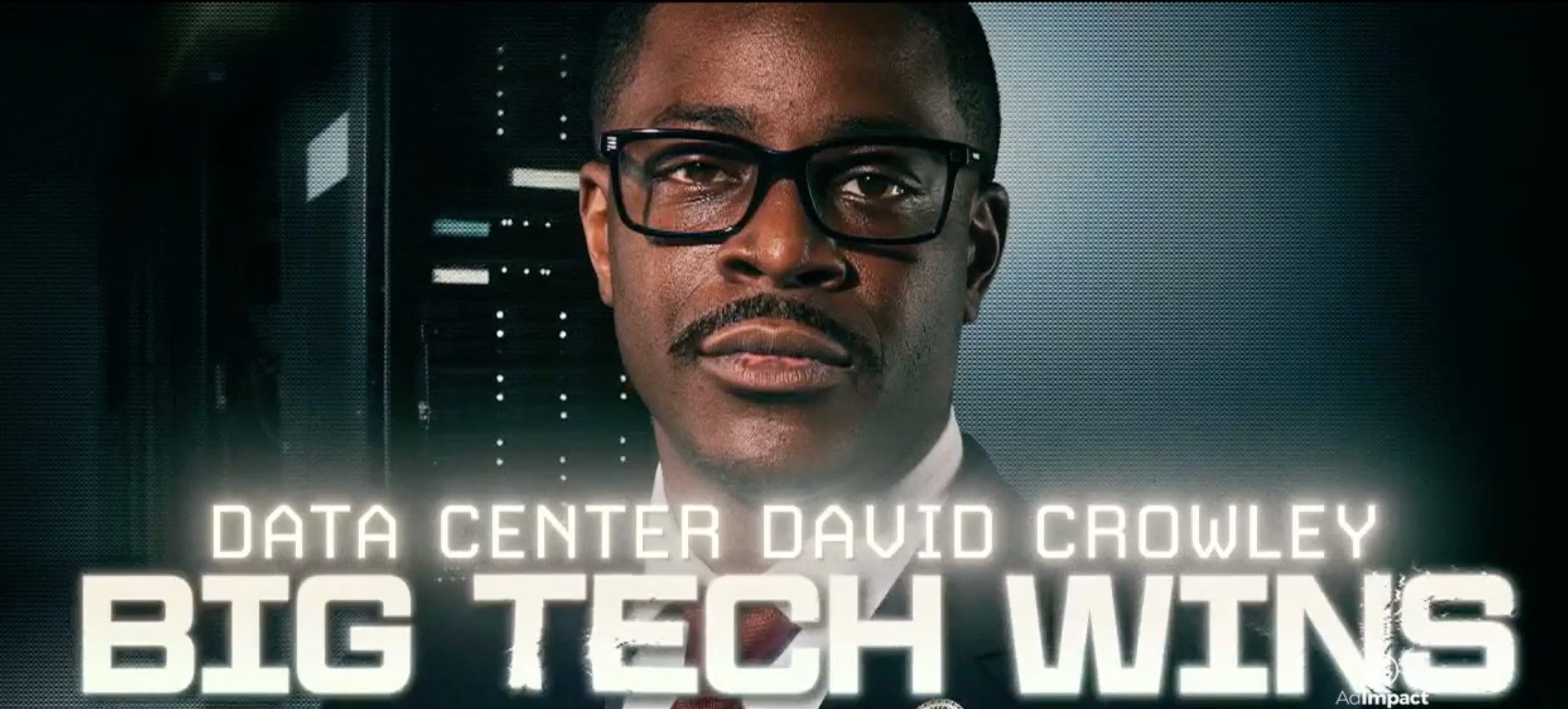
“Data Center David,” the ad blares, followed by footage of Crowley lauding the opportunity for Wisconsin to become an “AI and data hub” not just nationally, but globally. The ad, which could just as easily have been run by a progressive Democrat, closes by accusing Crowley of taking hundreds of thousands of dollars from data center special interests.
In Pennsylvania’s eighth district, one of Democrats’ top pickup opportunities nationwide, Paige Cognetti made data centers the focus of a major Summer ad buy. “Big companies have come before, taken what they wanted and left us with their mess to clean up,” Cognetti says to camera. “Now, it’s data centers.”

A Political Coalition There For The Taking
Alyssa Cass, who advised AI-engineer turned pro-regulation champion Alex Bores in his NY-12 primary campaign, says that boiling community anger presents a clear opportunity to build something bigger: “to ride a populist wave and rebuild a national coalition against what is a power grab by a handful of AI oligarchs that threatens our safety and the fabric of our society.”
Bores yesterday launched Who Decides, a $30 million effort to “build the winning Democratic answer to AI” – a message that’s “desperately needed” Cass said.
“It’s a slam dunk for Democrats to seize a populist, pro-working-class approach to AI,” says former Sanders advisor and Biden official Alex Jacquez. “It fits perfectly: who gets to decide, who gets to win, how are the gains going to be distributed? There are clear, unlikeable villains and clear heroes for the story.”
President Trump, meanwhile, has not been making the issue particularly hard for Democrats to exploit. Despite acknowledging that data centers could use “a little public relations help,” he’s also said that if he were a mayor or governor, he’d want “as many data centers as I can.”
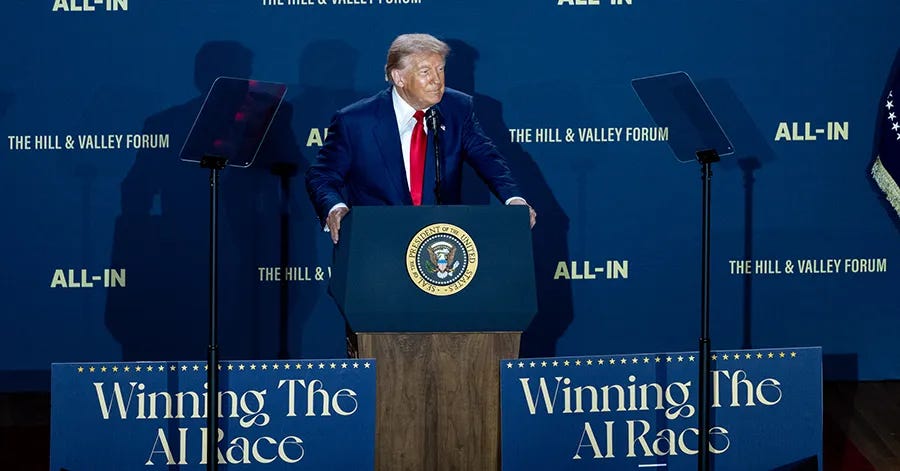
“Let Data Reign,” he posted in August. Days later he suggested that communities who reject data centers would “go through poverty, crime, and squalor.” Just this week, he posted that data center outrage was a “SICK conspiracy theory” designed to benefit China.
Industry leaders, meanwhile, are now standing up a $50 million counteroffensive to stem the tide of data center opposition – although it appears to be focused on specific local communities.
But while Trump and the industry would see the backlash as a series of isolated local skirmishes, it’s clear that the forces driving it – anxiety over AI, populist rage at Big Tech, and a growing sense of political and economic powerlessness – are only intensifying and expanding.
What remains to be seen is whether leaders in either party are capable of assembling a coalition around a coherent broader vision that feels real and actionable to regular people – an agenda that would wrest control from corporate monopolies and their allies, ensure gains flow to everyone rather than concentrating power further, and give voters a far greater say over the economic, political and technological forces reshaping their lives.
7 Hard Lessons Democrats Must Learn in 2026

In the closing weeks of 2025, Liberty and Power conducted in-depth interviews with a cross-section of leading Democratic pollsters and messaging experts on the party’s best path forward. The conversations included vet…